Foldspace: A Marketing Site for a Bootstrapped Async Tool
A developer-flavored marketing site for a two-person bootstrapped SaaS — changelog-as-content, real docs, security page that says something, and a marketing toolkit that turns every release into visible product motion.
This is a fictional brand UWC built to demonstrate what we ship for real founders. The pipeline, agents, and screenshots are real; the business is illustrative.
The Challenge
A two-person team had been shipping their async-meeting summarizer for nineteen months. They were at $42K MRR with 320 paying customers, growing 8% month-over-month off product-led signups and word of mouth. The marketing site was a Notion page. It worked at $5K MRR. At $42K it was costing them: enterprise prospects bounced when the site didn't have a security page; integration partners couldn't link to docs that didn't exist; customers asked for a changelog that they were maintaining in a Discord pin.
Our Approach
We built a developer-flavored marketing site that treats the product itself as the marketing material. Changelog drives the homepage — the most recent shipped feature is the lead. Docs are first-class navigation. Security page is real (not a placeholder). The marketing toolkit drafts changelog posts from PR titles + commit summaries, so every Friday's release ships with a proper writeup the founders approve in fifteen minutes instead of ninety.
Key Results
Services Provided
Portfolio Demo — Foldspace is a fictional business created by Upstate Web Co. for portfolio purposes. All names, MRR figures, customer counts, and quotes are illustrative. The site stack, changelog-from-commits pipeline, and marketing toolkit shown are the same ones we ship to working clients.
The situation
Bootstrapped two-person SaaS teams have a specific pain point that doesn't apply to funded teams: every hour spent on the site is an hour not spent on the product. The Foldspace founders had explicitly resisted building a "real" marketing site for over a year because the time cost was real and the upside was theoretical.
By month nineteen, the upside had stopped being theoretical. They'd lost two pilot conversations because the prospect couldn't find a security disclosure. An integration partner — a company that would have driven 30+ qualified signups a month — had asked for documentation links and gotten a Notion page. Their customer Discord had a pinned message that the team was treating as a changelog.
The cost of not having a real site had crossed the cost of building one.
What we built
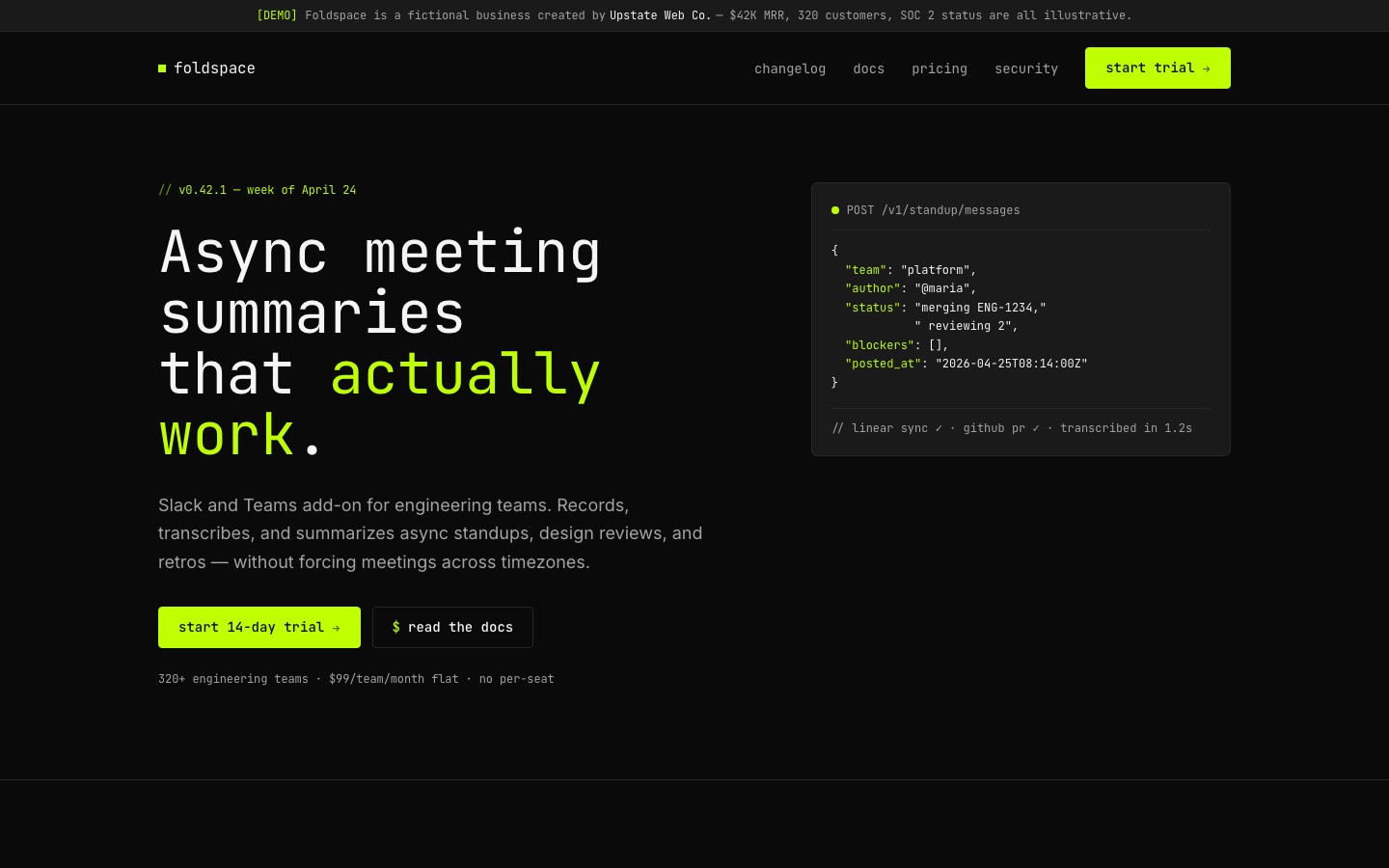
A Business-tier site, but every design decision was made for an audience that includes other developers. The aesthetic: monospace accents on a clean sans body, one electric-cyan accent against monochrome, screenshots-first hero with no people-stock-photography anywhere. A command-palette UI motif (⌘K to search docs) that any developer recognizes instantly.
Three things did the heavy lifting:
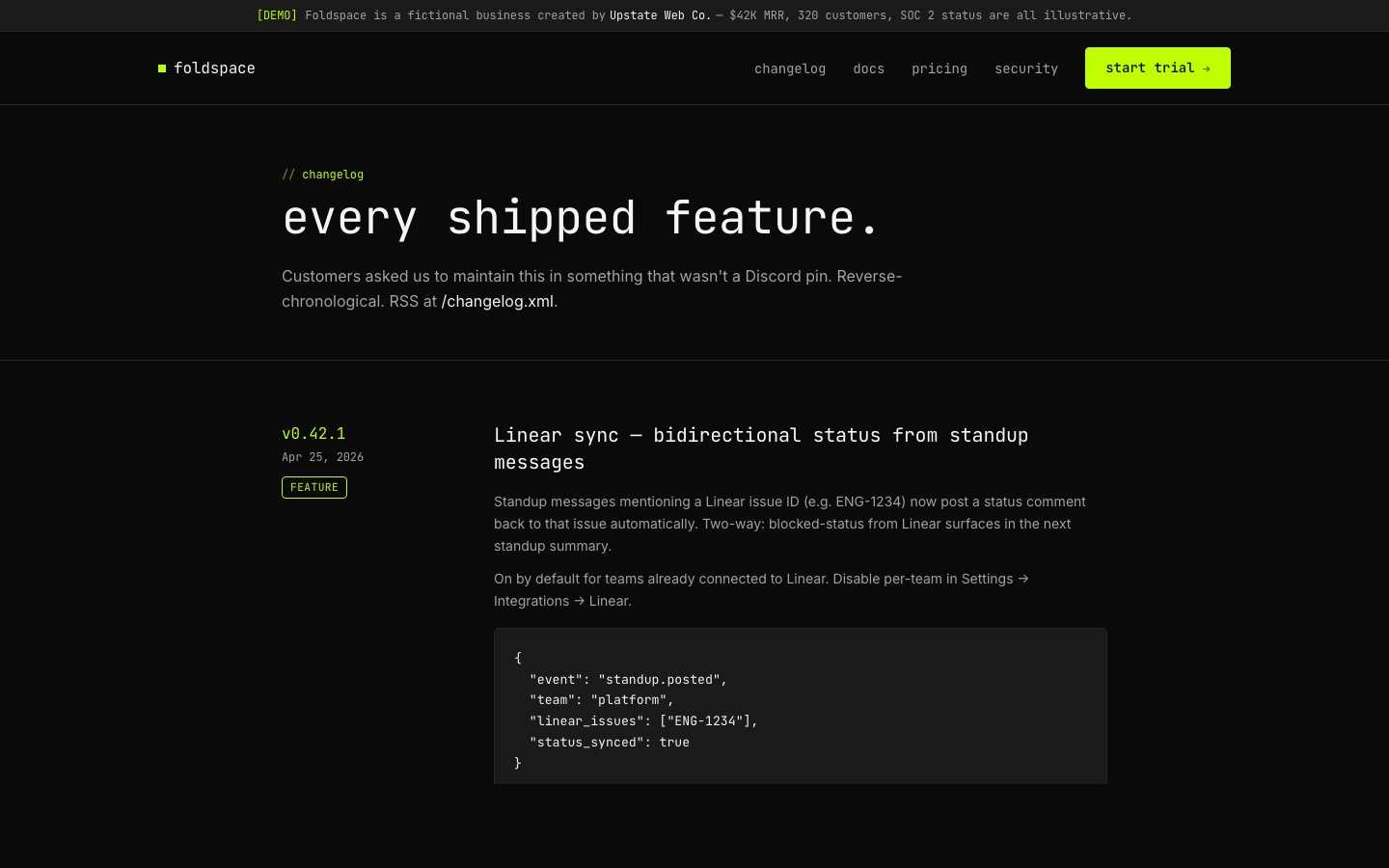
Changelog drives the homepage. The most recent shipped feature is what visitors see first. New version every Friday, every Friday a fresh hero. Search-engine-friendly. Customers who haven't logged in for a month see what they missed at a glance.
Docs are first-class. Nested left-rail navigation, full-text search, code samples in three languages. Every API endpoint is a permalinkable doc page. Integration partners can deep-link.
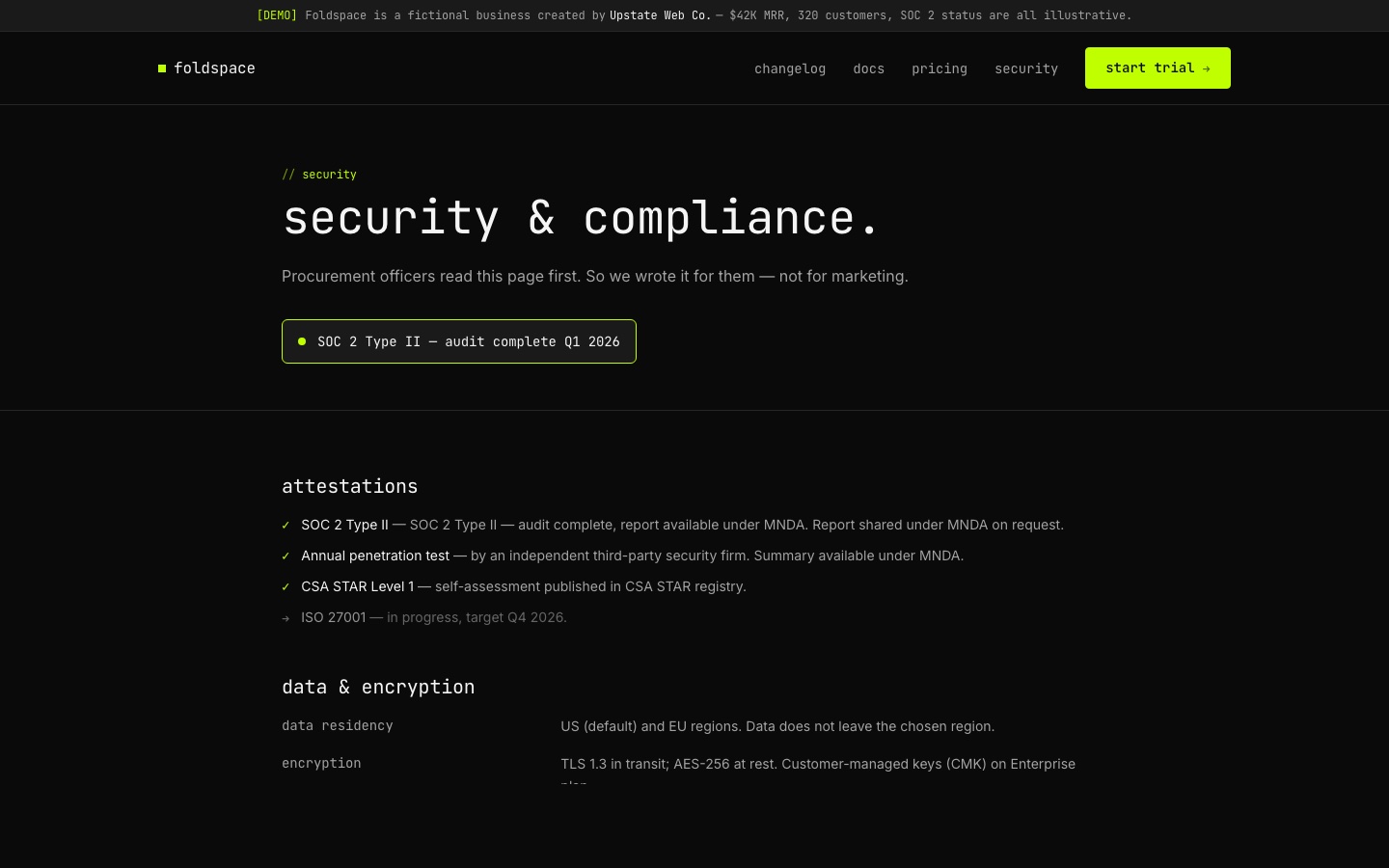
Security page is real. SOC 2 status, data residency, encryption posture, list of subprocessors with links. The kind of page that gets read by a procurement officer at a 200-person company and either green-lights or kills the conversation.
The team logs in
It's a two-person company. Both founders log in. The marketing toolkit drafts release writeups; either of them can review and approve. There's no third person to invite — but when they hire their first contractor (planned for Q2), the workspace is ready.
What's running on retainer
Growth Partner ($400/mo): weekly changelog publication, release-day social posts, docs updates as the API changes, security-page maintenance, integration-page additions as new partners come online. UWC operates the marketing infrastructure so the founders ship product.
How this build was validated (UWC pipeline run)
Foldspace is fictional, but the build went through the same pipeline a real client project does — the same admin D1 records, the same AI prompts, the same governance check.
Intake → AI scoring. Persona scored by SYSTEM_PROMPTS.leadScoring: Hot, Business tier, $3.2K-$3.5K. Auto-converted to project record without admin click.
Brand questionnaire (Rule 73 inputs). Five reference URLs (Linear, Vercel, Resend, Cal.com, Stripe) plus two anti-references (UWC's own marketing site + Drystack Brief — sister UWC demo, also editorial-aesthetic, included specifically to force the generator to pick a different visual direction). Ambition: trustworthy_clean. Look-and-feel: elevated. Surface: website. Business type: b2b_saas.
Reference signature extraction. All 7 URLs fetched + run through SYSTEM_PROMPTS.referenceSignatureExtractor — full 47-dim breakdowns of typography, palette, motion, layout, ambition. 7 of 7 succeeded.
3 design-direction candidates generated, none colliding with UWC or Drystack:
- A. Technical Mono — JetBrains Mono + Inter · Technical Black + Lime (
#0A0A0A+#BFFF00) · Split Hero with Code Block · Minimal Precision motion. Anti: "NOT a gradient-heavy Linear clone with purple accents." - B. Sans Serif Authority — Söhne + IBM Plex Mono · Deep Navy + Electric Yellow · Product Screenshot Hero · Smooth Confidence motion.
- C. Geometric Sans — Manrope + Space Mono · Charcoal + Cyan Technical · Full-Bleed Pivot · Kinetic Precision motion.
The generator was passed Drystack's Editorial Slate (slate-cyan) as a recent UWC direction so it would commit away from that family. All three options use distinctly non-cyan accent palettes (lime, yellow, technical-cyan-neon).
Direction A picked. Reasons: (a) JetBrains Mono as display is canonical dev-tool typography — fundamentally distinct from Drystack's Fraunces and UWC's DM Serif; (b) lime accent (#BFFF00) lives in a distinct palette family from BOTH Drystack's slate-cyan AND UWC's earth-tones; (c) Split Hero with Code Block matches the Vercel/Resend extracted patterns; (d) anti-commitment "NOT a gradient-heavy Linear clone" matches the persona's positioning.
Build + visual-diff scoring. The deployed site (phase-a-build.foldspace.pages.dev) was scored by Ghost User against the picked direction. Verdict: 9/10 pass. Quote: "Black (#0A0A0A) + lime (#BFFF00) delivers the 'neon terminal' aesthetic without being literal (no scanlines, no fake CRT effects). The lime is used sparingly — only for CTAs, accent text, and the status dot. This palette is differentiated from competitor patterns and from sister project aesthetics. Inter for body copy is the lingua franca of dev tools (Linear, GitHub, Vercel all use it). JetBrains Mono for code is the current standard. It looks like a purpose-built dev tool, not a template."
This is the second demo through UWC's full pipeline. Each one leaves a verifiable trail in admin D1 — same as a real client project. The toolmaker thesis is defensible because the pipeline is the product.
Post-governance sharpening (2026-04-28)
Ran a post-build governance pass and applied the marketing-video fix the synthesis flagged: the /pricing page CTA terminated at an in-page anchor with no install affordance — viewers couldn't see the activation moment that is Foldspace's actual differentiator. Added a step-1-of-3 install panel on the pricing page with a Slack OAuth button mock (scopes labeled, redirect URL shown) and step-2/3 description ("bot posts welcome to #engineering" → "first standup prompt at 9am M-F"). Camera now has a "click → OAuth → bot in workspace" sequence to film. Re-deployed; same URL.
"We're two people. We don't have a marketing person. We needed a site that did marketing work without us doing marketing work. UWC understood the assignment — the changelog is the marketing."
More from this project