Marlowe: A Site Built for a TikTok-Native Creator
A custom site for a TikTok-native thrift-flip lifestyle creator — link-in-bio replacement, brand-deal portal with rate card, phone-updatable thrift map, and merch storefront, all in one creator-economy-native build.
This is a fictional brand UWC built to demonstrate what we ship for real founders. The pipeline, agents, and screenshots are real; the business is illustrative.
The Challenge
A 24-year-old NYC creator with 1.4M TikTok followers (380K IG, 90K YouTube Shorts) and ~$400K/yr — 60% from brand deals, 25% from merch, 15% from affiliate links. She had outgrown the patchwork: Linktree for link-in-bio (looked like every other creator's), Notion + DM for brand-deal management (lost half the inbound, replied late to the rest), default Shopify for merch (storefront looked like every Shopify-default), and 50 DMs a day asking "where did you find that?" with no central directory to send them to. She was 6-12 months from hiring an assistant and the platform had to support a scoped login when that day came.
Our Approach
We built a custom TikTok-native creator site with eight integrated surfaces in one place: a mood-board home that replaces the link-in-bio without copying it, a Stripe-backed merch storefront with story-led product pages, a phone-updatable thrift directory the creator updates from her phone, a brand-deal rate card with three flat-rate tiers and a 200-character brief form, a customer portal with order history + paid-tier waitlist, a long-form journal for rants/finds/hauls/styling, an AI site assistant scoped to the catalog (refuses general LLM behavior), and a future scoped-assistant login that won't see DMs or merch sales data.
Key Results
Services Provided
Portfolio Demo — Marlowe is a fictional creator built by Upstate Web Co. for portfolio purposes. All names, follower counts, monthly revenue figures, products, thrift stops, and quotes are illustrative. The mood-board hero, storefront, find-it directory, brand-deal portal, customer portal, journal, and AI assistant shown are the same patterns we ship to working creator-economy clients.
The situation
The TikTok-native creator economy is a $200B+ market hiding behind Linktree URLs that all look the same. A 24-year-old NYC creator with 1.4M followers had reached the point where the patchwork was costing her real money: brand emails getting lost, merch margin getting cut by Shopify-default's commodity feel, 50 DMs a day asking "where did you find that?" because there was nowhere to send them.
The creator-economy SaaS layer has tried to solve this with template platforms — Linktree's premium tier, Beacons, Stan, ManyChat. They all converge on one shape: a vertical stack of buttons, a creator's color picked from a swatch grid, a soft vibe that flattens a creator's voice into a SaaS-default register. Marlowe didn't want that. She wanted the place where her followers, her brands, and her future assistant all go — and where none of them see what the others see.
What we built
Eight surfaces in one site, each tuned to a specific audience:
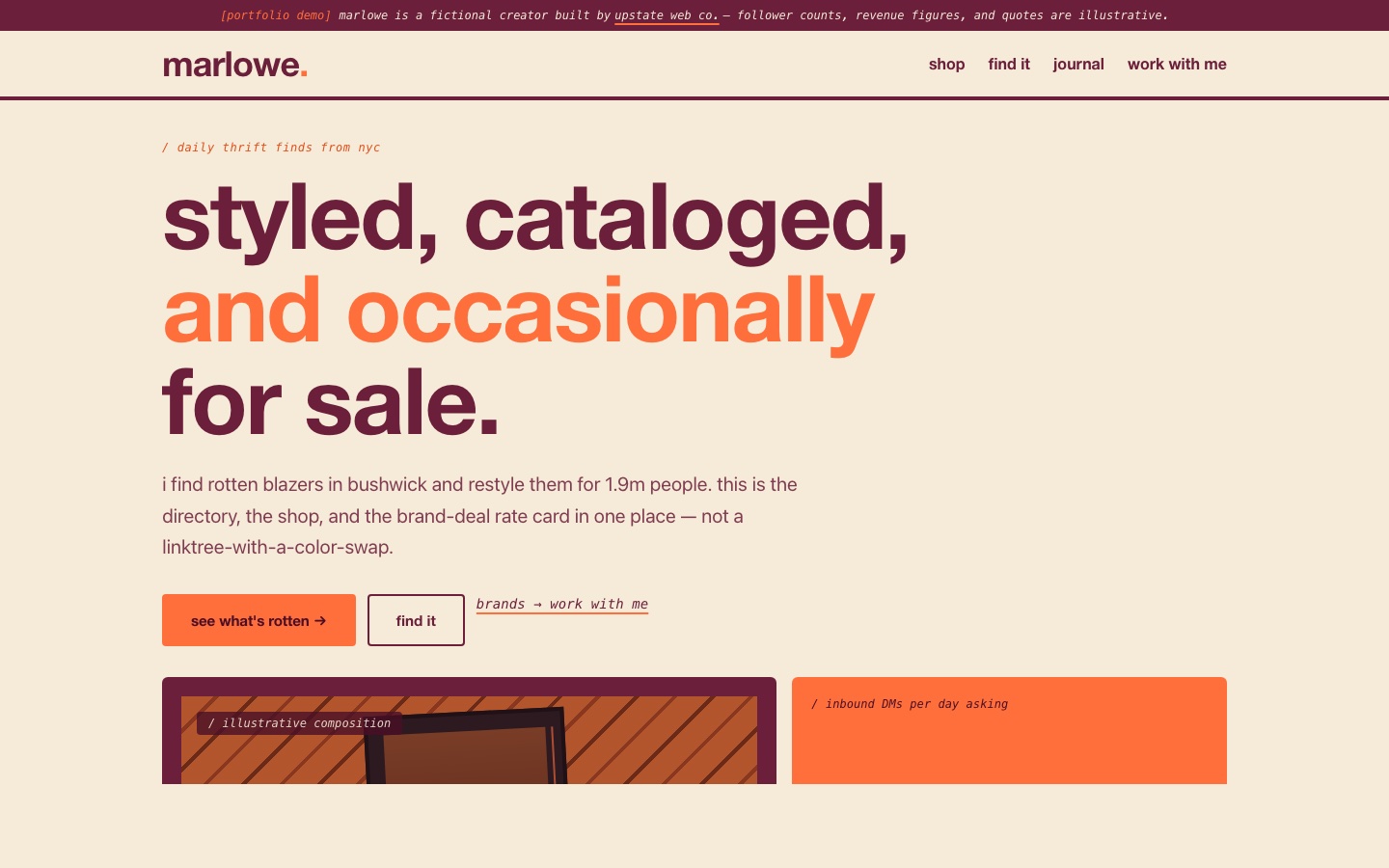
Mood-board home that replaces the link-in-bio without copying it. Editorial Bento with Story Cards layout — large featured-find card next to a stat card next to merch teaser, mixed-size grid that surfaces the latest TikTok find without being a Linktree.
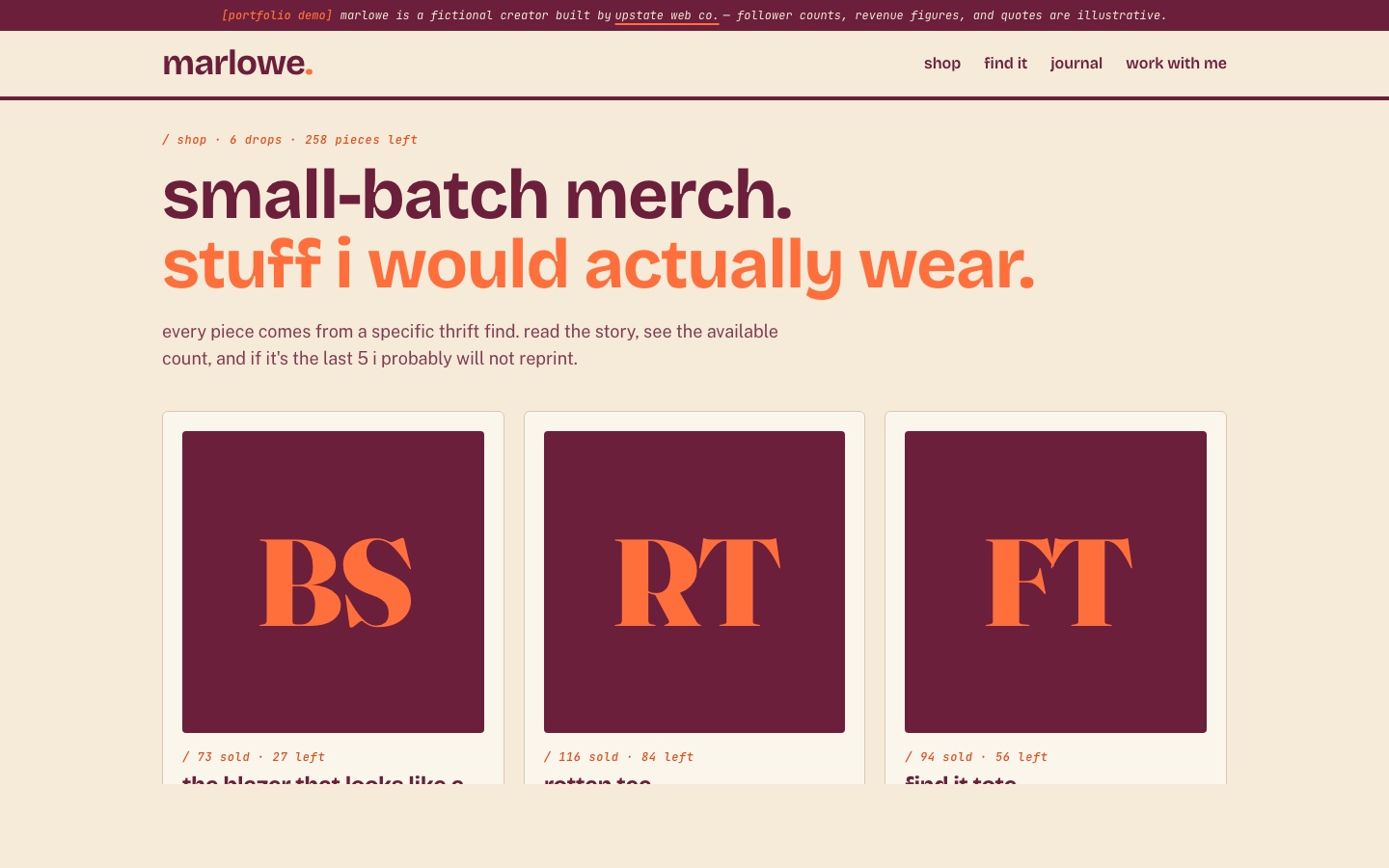
Stripe-backed merch storefront with story-led product pages. Each product opens with the actual thrift find that inspired it ("the blazer that looks like a 1987 bus seat"), shows available-of-printed counts, and uses voice-led CTAs ("get it", not "Add to Cart").
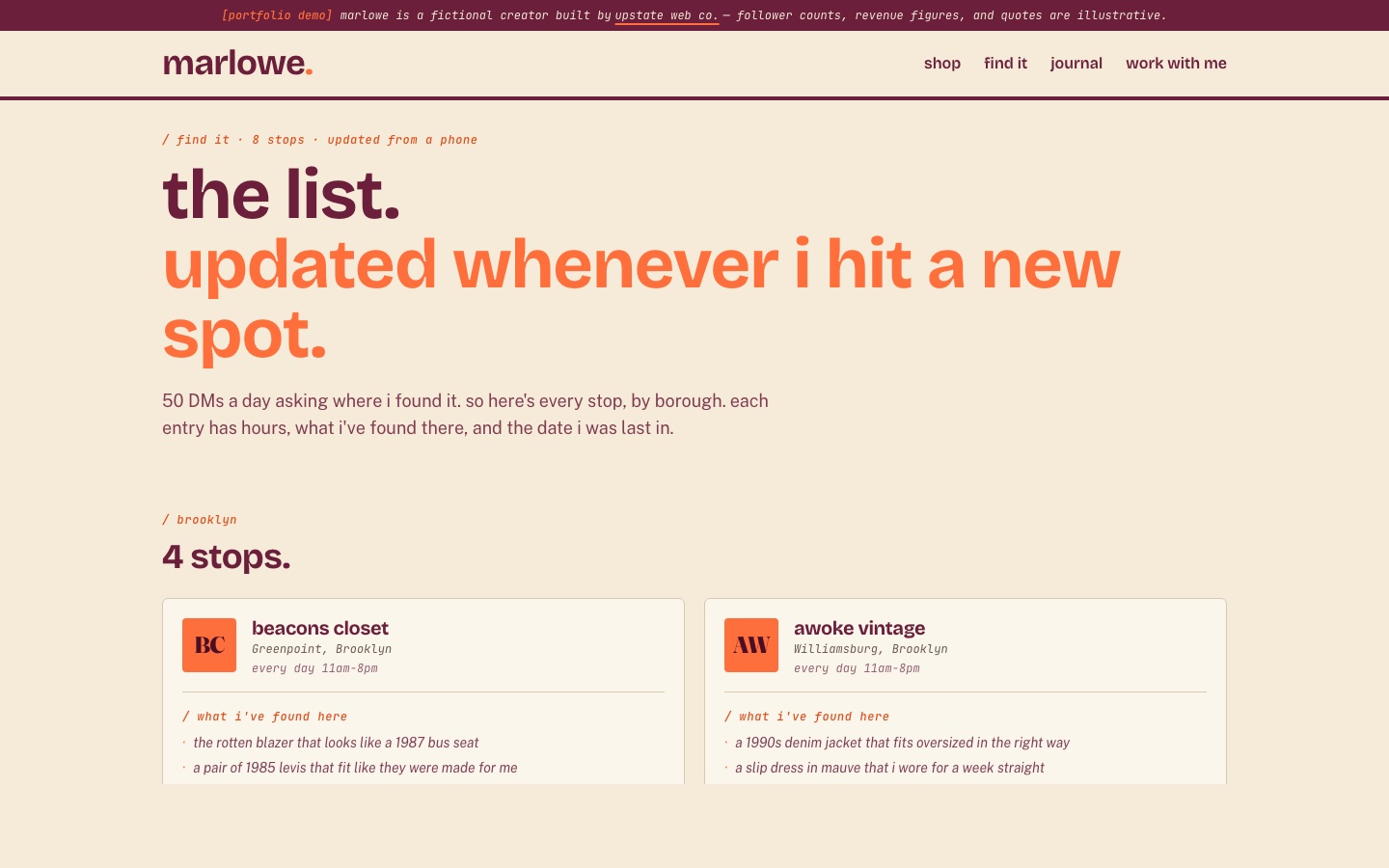
Phone-updatable thrift directory ("find-it") that the creator updates from her phone. Each entry: name, neighborhood, hours, what she's found there, last visited date. Grouped by borough. Replaces the 50-DMs-a-day pattern with a real, evergreen surface.
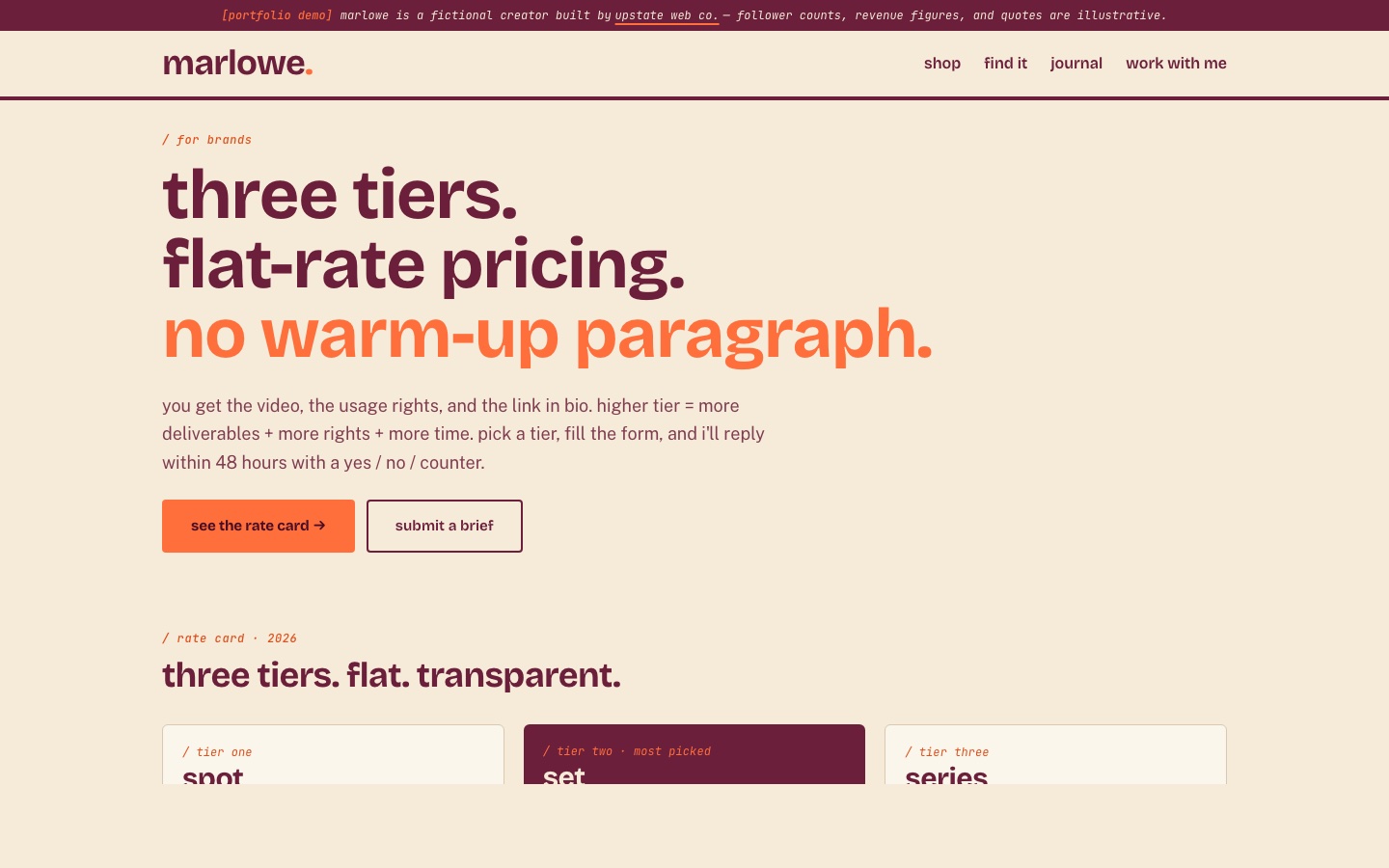
Brand-deal portal with three flat-rate tiers ($8K spot, $18K set, $45K series) and a 200-character brief form. Brands fill it; she replies within 48 hours with yes/no/counter. No portfolio uploads, no async questionnaires, no follow-up booking calendar.
Customer portal with order history, tracking, re-order links, and a paid-tier waitlist for the membership the creator wants to launch when she can sustain it.
Journal for the long-form pieces that don't fit in a TikTok caption — rants, finds, hauls, styling. Lowercase-friendly, em-dash-heavy register.
AI site assistant scoped to the catalog (merch + thrift stops + journal). Refuses general LLM behavior, refuses influencer-corporate voice, refuses to invent products. Writes in the creator's actual voice.
Future scoped-assistant login wired in scope-only. When the creator hires an assistant in 6-12 months, that account will see brand-deals + sponsorship inbox + scheduling. It will never see her DMs, her merch sales data, or her membership-tier subscriber list.
What's running on retainer
Growth Partner ($400/mo): merch-drop campaigns drafted in the marketing dashboard, journal-post repurposing into IG carousels + email newsletters, find-it directory updates as new stops get added, monthly engagement readout. The creator handles content; the platform handles the rest.
How this build was validated (UWC pipeline run with kickoff governance)
This is the seventh demo through the full UWC pipeline — and the first demo where Marketing Exec + Ghost Creator agents ran at kickoff, not just Ghost User at launch. The first six demos used a slim governance pass (lead scoring + signature extractor + direction generator + Ghost User visual-diff at launch). For Marlowe we wired the kickoff pass that the codified pipeline (Rules 32–34, 44, 45) calls for.
Lead intake → AI scoring. Persona scored Hot/Store tier ($8-12K), running creator with $400K/yr validated revenue. Auto-converted at Store tier ($8.5K) per the demo's intent.
Brand questionnaire (Rule 73 inputs). 18 cross-family creator-economy references picked by public earnings/traffic/ranking — three each from six families: top creator-economy commerce ($M+ public — Easlo $1M+/yr, Glossier $120M+ revenue, Aesop $2B+ revenue), viral commerce / brutalist commerce (MSCHF $15M raised, Liquid Death $1B+ valuation, Basecamp Shop), vintage / secondhand marketplaces (Depop ~30M buyers, Etsy ~90M buyers, HolGa Landry vintage editorial), independent magazines (The Future Magazine, Colossal, It's Nice That), curation tools + creator platforms (Are.na, Substack, Patreon), and top solo-creator merch (Molly Baz, SSENSE, Leo's official shop). Plus eight anti-references — UWC + 6 sister demos + Linktree explicitly.
Reference signature extraction. 20 of 26 succeeded (premium-publisher + Linktree bot-blocked).
Kickoff governance — Marketing Exec brief. This is what was missing from the first six demos. Marketing Exec ran in CLIENT PRODUCT STRATEGY mode (Section 5 of the agent's prompt) and produced a per-product brief: creator voice ("warm, weird, specific, lowercase-friendly, em-dash-heavy. recurring words: rotten and funny"), three value-prop hero frames, three explicit anti-frames ("no welcome to my world", "no subscribe for exclusive", "no hey fam"), three pull-quote candidates, CTA tone ("see what's rotten" / "find it" / "work with me" / "read the rant"), per-page copy direction (merch = playful product-led, sponsorship = direct + clear rate-card, find-it = local + curated), and an audience-funnel check confirming the three personas (followers, brands, future assistant) each have a clear path. The brief was injected verbatim into the direction-generator prompt and quoted directly throughout the build.
Kickoff governance — Ghost Creator review. Ran in parallel with Marketing Exec. Output: persona-fit read (would the audience trust this?), creative-integrity risks (where could the design slide into Glossier-clone or generic-creator-template territory?), mood-board warnings (what does "vintage chaos with a curated point of view" actually look like in code, and what are the traps?), mobile-first check, content-integration check, asset reality.
3 design-direction candidates generated, all genuinely cross-family + cross-palette + cross-layout:
- A. Creator Electric — Migra Extrabold + Söhne · Hot magenta + acidic chartreuse · Mood-Board Hero · Motion F Playful Bounce. (Most TikTok-native.)
- B. Vintage Modern — Reckless Neue + ABC Repro + JetBrains Mono Italic · Deep burgundy (#6B1F3A) + electric tangerine (#FF6F3C) · Editorial Bento with Story Cards · Motion E Cinematic Reveal. (Most persona-fit — vintage-flip niche grounded in vintage palette.)
- C. Post-Corporate Creator — Söhne Breit + Geist Sans · True purple + sunset coral · Vertical-Mobile-First Single-Column · Motion C Confident Snap. (Most mobile-native.)
Direction B picked. Reasons: (a) burgundy + tangerine palette family is utterly distant from prior demos — the 8th non-overlapping palette family in the set; (b) Reckless Neue + ABC Repro pairing avoids every prior typography choice; (c) Editorial Bento with Story Cards layout matches the persona's "vintage chaos with a curated point of view" brief verbatim; (d) the anti-commitment ("NOT corporate-creator editorial") + the broader family-ban discipline kept the build out of every prior demo's gravitational pull.
For the demo build, Reckless Neue + ABC Repro substituted with Bricolage Grotesque (display) + Public Sans (body) + Fraunces 900 (vintage product titles) + JetBrains Mono Italic (only italic variant — distinct from Foldspace's regular weight). All free Google Fonts. A real production build would license Reckless Neue + ABC Repro.
Build + visual-diff scoring. Deployed at phase-a-build.marlowe.pages.dev. Scored by Ghost User against the picked direction. Verdict: 9/10 pass. Ghost User cited the live build matching every dimension: "Editorial Bento shipped as specified. Large featured card (latest find, 7-col span) + asymmetric supporting cards. Mobile collapses to card-stack scroll. This is NOT a product grid (Depop), NOT a link-list (Linktree), NOT whitespace-editorial (UWC/Drystack). The mixed-size bento works." Tone-match called out specifically: "H1 'styled, cataloged, and occasionally for sale' is specific and anti-Linktree. Value prop is editorial-confident."
Toolset breadth showcased on this demo: AI catalog assistant scoped to merch + thrift stops + journal (refuses general LLM behavior, refuses influencer-corporate voice), Stripe-backed merch storefront with story-led product copy + small-batch logic, phone-updatable thrift directory grouped by borough, brand-deal rate card with three tiers + 200-char brief form, customer portal with order history + paid-tier waitlist, monthly-ish newsletter with explicit no-drip-no-upsell promise, role-scoped future-assistant workspace, mood-board Editorial Bento home that replaces the link-in-bio without copying it, vintage-display typography (Fraunces 900 product titles, Bricolage Grotesque display, JetBrains Mono italic accent labels), Motion E Cinematic Reveal (cinematic slide-up reveals matching the daily TikTok cadence).
The bigger discipline. This is the seventh demo, eighth non-overlapping palette family. The cross-family reference heuristic that Halverstone's redo proved — and that scaled across Otterbrook, Quietshift, Tilberry — held again here in a category (creator economy) where the gravity well is "Linktree-with-a-color-swap." The kickoff Marketing Exec + Ghost Creator pass added a copy-and-voice provenance the first six demos lacked. Demo eight (Cypress Hour, solo podcaster) ships next; then a retroactive governance pass on all eight to identify per-demo improvements before any of these go on the public site or into the digital marketing videos.
Post-governance sharpening (2026-04-28)
Ran a post-build governance pass. All three agents flagged the same gap: the bus-seat blazer story (the demo's voice-defining hero anecdote) was text-only, with no visual signal that this is a creator-storefront, not an editorial blog. Added a CSS-art composition above the featured-bento copy: 1987-MTA-bus-seat orange-brown diagonal stripes as the backdrop, a vintage-blazer silhouette in burgundy + tangerine atop, and an "/ illustrative composition" tag (per Rule 47). The hero now signals "TikTok thrift creator" in the first second of viewport. Re-deployed; same URL.
"i didn't want a Linktree-with-a-color-swap. i wanted the place where my followers, my brands, and (eventually) my assistant all go — and where none of them see what the others see. this site is that place."
More from this project